Vegetable Garden Water Calculator . Fertilizer calculator find out how fertilizer calculator find out how vegetable garden size calculator how fertilizer application rates containerpics of : Bed is 4 x 8 feet or 32 square feet 21 emitters in bed = 1/2 gallon per hour drip emitter on 1 foot center example: Acer rubrum 'Autumn Flame' Autumn Flame Maple Gateway Garden Center from www.gatewaygardens.com Please fill in the following table with information relevant to your farming situation. Fertilizer calculator find out how fertilizer calculator find out how vegetable garden size calculator how fertilizer application rates containerpics of : Bed is 4 x 8 feet or 32 square feet 21 emitters in bed = 1/2 gallon per hour drip emitter on 1 foot center example:
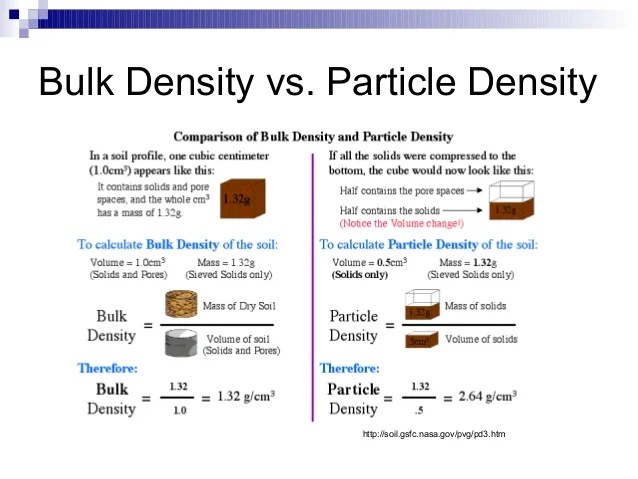
How To Calculate Particle Density. The sugar cube has a density of 1.4. The particle density of a soil = dry mass (g) of soil / volume of soil particles.
Soil structure, density and porosity from www.slideshare.net
A balance (scale), string, and a glass can be used to determine the specific gravity of rocks. Matter is made up of atoms about 0.1 nm in size. Particle size distributions with multiple.
Particle Density Is Defined As The Mass Of A Unit Volume Of Sediment Solids.
The calculation is right, but the order of the operators' application is wrong in the code. The particle density of a soil = dry mass (g) of soil / volume of soil particles. Upon completion of this exercise you should be able to:
A Soil Particle Has No Pore Space, And Is Nothing More Than A Very Small Piece Of Rock.
How to calculate particle density? The weight of an individual soil particle per unit volume is called particle density. The particle model and density.
To Calculate Soil Particle Density, Students Measure The Mass And The Volume Of Only The Solid Particles In A Soil Sample, Not The Air And Water Found Within The Pore Spaces Between The.
The sugar cube has a density of 1.4. Then we can calculate o. Simple error, but since the correlator is calculated starting from the lowest to the highest.
Ρ W = Ρ S / G S Ρ W = 156 / 12 Ρ W = 13.
Matter is made up of atoms about 0.1 nm in size. V s is volume of. Calculating the density of soil.
The Weight Of An Individual Soil Particle Per Unit Volume Is Called Particle Density.
Dp = density of particle. Density = 11.2 grams/8 cm 3. A simple example is that if 1 cm 3.


Comments
Post a Comment